
The Carpet Guy / JOURNAL
Carpet Patch Repair In Auckland : Why Replace When You Can Repair ?
Updated 18 November 2026 · By The Carpet Guy
Burns, stains, pet damage or tears? See how carpet patch repair works, what a good repair looks like, DIY limits and when to replace. Auckland.
QUESTION: Can a burnt, stained or torn patch of carpet be repaired without replacing the whole carpet ?
ANSWER: In most cases, yes. A patch repair cuts out the damaged section and bonds in a matching piece, usually taken from a spare offcut or a hidden spot like the inside of a wardrobe. Done well, a carpet patch repair in Auckland is very hard to spot. Done badly, it looks like a square on the floor, and the difference comes down to the match and the finishing.
A cigarette burn in the lounge. A dog that’s chewed the corner of the bedroom carpet. A red wine stain that three cleaners couldn’t shift. The first thought is usually that the whole carpet has to go, and that thought is usually WRONG, and expensive.
This guide explains what a patch repair involves, which damage can be patched, why the replacement piece matters more than anything else, and when you’re better off leaving it to a professional. If you want a quote for your own carpet, the details are at the bottom of the page.
What Is A Carpet Patch Repair ?
A patch repair removes the damaged section of carpet and fits a matching piece in its place. The new piece is bonded to the surrounding carpet so that the join sits flat and the pile blends across it.
It’s the right answer when the damage is limited to one area and the rest of the carpet is in good shape. It keeps the carpet that still matches the room, avoids the cost of new carpet and underlay, and takes hours rather than days.
What Damage Can Be Patched ?
Most localised carpet damage can be repaired. Common jobs include:
- Burns and cigarette marks. The burnt tufts are cut out and replaced.
- Pet damage. Scratched, chewed and snagged carpet can usually be patched, and so can pulled loops.
- Permanent stains. Some stains are permanent, from bleach, dye, rust or paint. If cleaning can’t shift it, the stained section can be replaced.
- Tears and cuts. These can happen when furniture is dragged or an appliance is moved.
- Holes from removed fittings. Cables, old door stops and removed fixtures sometimes leave holes or marks.
- Damage from wardrobe, plumbing or electrical work. Where the carpet has been cut for access, it can be patched back in. There’s more on this in the guide to relaying carpet after wardrobe installation.
The Replacement Piece Matters Most
Anyone can cut a hole in carpet. The skill is in the matching piece, and it’s what separates a repair you’ll never notice from one you’ll see every day.
So where does a matching piece come from ?
- A spare offcut. The best source is a leftover from the original installation. If you’ve got one in the garage or a cupboard, keep it.
- A hidden spot. If there’s no offcut, a repairer can often take a piece from inside a wardrobe, under a heavy piece of furniture or from a hidden corner. The visible damage gets an identical match, and the small hole is patched in a place nobody looks.
- A purchased match. If the carpet is still available, a close match can sometimes be sourced, but older carpet is often discontinued.
Three things decide whether the match works:
- Pile direction. Carpet looks darker or lighter depending on which way the pile lies. If the patch is turned the wrong way, it will show up as a different colour even if it’s the same carpet.
- Pattern. Patterned carpet has to be lined up across the join, which takes patience and a good eye.
- Fading. Carpet in a sunny room fades over years. A piece from a dark wardrobe hasn’t, so a patch can be slightly richer in colour. In a sunny room, a good repairer will point this out.
Pro Tip For Homeowners: Before anyone cuts anything, find any spare carpet in the house and keep it. A decent piece of leftover carpet makes the difference between a repair that’s invisible and one that’s merely OK.
How A Carpet Patch Repair Is Done
The method is simple. Doing it well takes practice.
- Mark the pile direction on both the damaged carpet and the patch piece, so they go together the right way.
- Cut the damaged section out using a sharp knife and straight edge, or a patch cutter, and set the damaged piece aside.
- Cut the patch to the exact same shape, either by cutting through the patch and the carpet together or by using the removed piece as a template.
- Bond it in. Hot-melt seaming tape goes under the edges and is heated with a seaming iron, so the patch bonds to the surrounding carpet’s backing.
- Press and finish. A seam roller presses the join flat, the pile is blended across it, and the area is checked from several angles.
A good patch is very hard to see. A bad one has visible edges, a ridge you can feel with your hand or pile that points the wrong way.
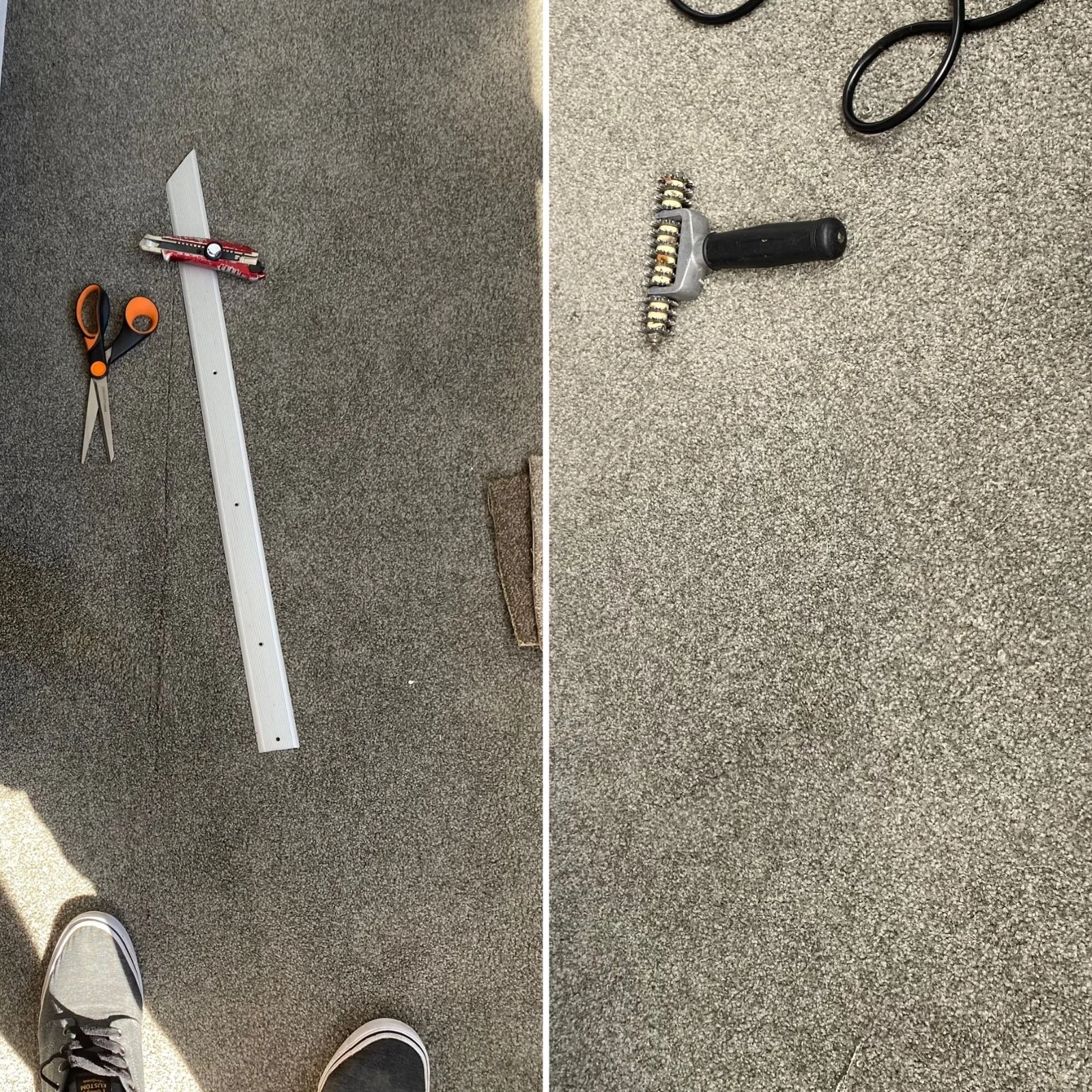
Essential Tools For Carpet Patch Repair
If you’re going to try it yourself, you’ll need:
- A matching piece of carpet from an offcut or a hidden area
- A sharp utility knife with plenty of new blades, because blunt blades pull and fray the pile
- A straight edge to guide clean cuts
- A measuring tape and a marker, to measure the damage and mark the pile direction
- Hot-melt seaming tape and a seaming iron, or strong double-sided carpet tape for a smaller, low-traffic repair
- A seam roller to press the join flat
- A heavy, flat weight to hold the patch while it sets
Can You Patch Carpet Yourself ?
Fair question, and the honest answer is sometimes.
A small burn in a spare bedroom, with a good offcut and a plain carpet, is a reasonable DIY job. If you’re patient, careful and willing to practise on a scrap first, you’ll probably get a decent result.
DIY gets risky when:
- The carpet is patterned, or the pile is unusual (loop pile, twist or a plush that shows every mark)
- The damage is in the middle of the lounge, where everyone sees it
- It’s wool or an expensive carpet you don’t want to experiment on
- You don’t have a matching piece
- You haven’t used a seaming iron before, because too much heat will melt synthetic pile
The risk is that a bad patch can be worse than the original damage, and it’s harder to fix afterwards. A hole that’s been cut too large is a bigger problem than the burn you started with.
Why Patch Repair Is Worth It
- It’s cheaper than replacing. You’re paying to fix one area, not to buy and fit a whole room of carpet and underlay.
- It’s quicker. Most patch repairs are completed in a single visit, often within a few hours.
- It keeps the carpet that matches. New carpet next to old carpet never blends in, so replacing one room can end up looking worse than a good repair.
- It’s more sustainable. Repairing carpet instead of replacing it keeps it out of the landfill, which matters when old carpet is bulky and hard to dispose of.
When Patching Isn’t The Answer
Patch repair isn’t the right call if:
- The damage covers a large part of the room
- The carpet is worn thin or flat across the whole floor
- The backing is failing, or the carpet has delaminated
- There’s widespread water damage or mould (see the guide to flooded carpet)
- You can’t find a suitable matching piece and the damage is in a very visible spot
A reputable repairer will tell you straight if the carpet is past saving. If someone offers to patch carpet that clearly needs replacing, ask why.
What Affects The Price Of Carpet Patch Repair In Auckland ?
Price depends on what needs doing, and it’s hard to say without seeing the carpet. The main factors are:
- The size and number of repairs
- The type of carpet, since wool, patterned and loop pile are harder to match
- Whether a matching piece is available, or has to be sourced
- Where the damage is, and whether the furniture has to be moved
- Whether the repair also needs the carpet restretching
A couple of clear photos of the damage, and of any spare carpet you have, will usually be enough to get a real quote.
Carpet Patch Repair FAQs
Will the patch be visible ? With a good match and careful fitting, it’s very hard to see. The closer the replacement carpet is to the original, the better the result.
How long does a patch repair take ? Most patch repairs are finished in a single visit, often within a few hours.
Can wool carpet be patched ? Yes. Wool can be patched like any other carpet, although matching it is harder. Send a photo for a first opinion.
What if I don’t have any spare carpet ? Don’t panic. A hidden section, such as inside a wardrobe, can often supply the piece.
Can a pulled loop in berber be fixed ? Often yes. Never pull a snag. Snip it level with the surrounding pile with scissors, and get it looked at if the loops around it are loosening.
Should I clean the carpet before or after a patch repair ? Repair first, then clean. A clean over a freshly repaired carpet helps the patch blend in.
The Final Word
Most carpet damage that looks terminal isn’t. Burns, stains, pet damage and tears in one area can be patched for a fraction of the cost of replacing the carpet. What matters is the match, the method and the finishing.
If the whole carpet has failed, replacement is the right call. If it’s one area, repair it.
Get A Free Carpet Patch Repair Quote In Auckland
Not sure whether your carpet can be patched ? Send a couple of photos of the damage and any spare carpet you have. Carpet patch repairs are available across Auckland.
Phone: 021 063 8772
Email: info@thecarpetguy.co.nz